 FactsLook
The Weird World of Jellyfish: How One Species Achieves Biological Immortality
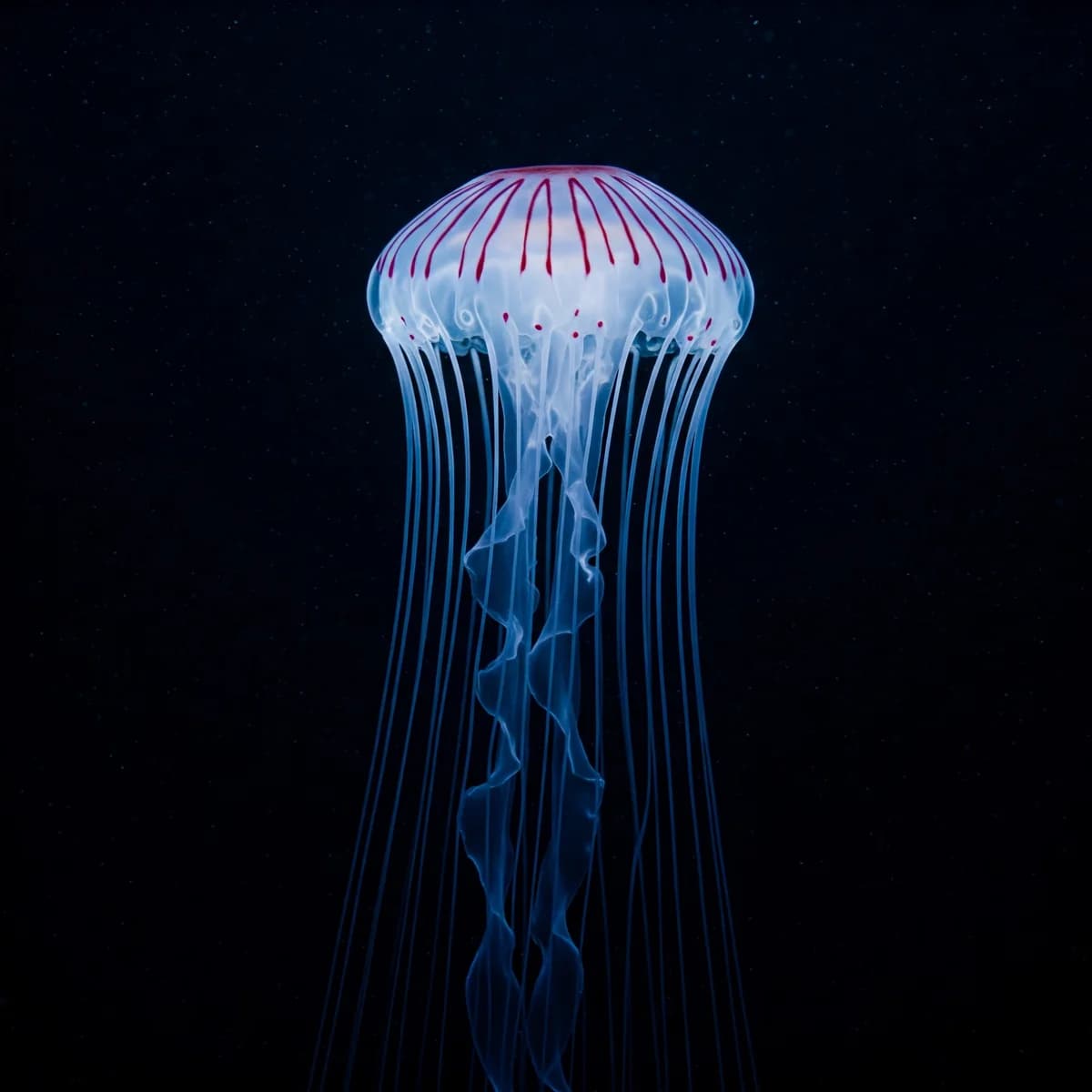
What even is a jellyfish — and why should you care?
A gelatinous blob with no brain, no heart, and no blood — yet jellyfish have survived on Earth for at least 500 million years, outlasting dinosaurs and dodging every mass extinction the planet has thrown at them. They drift through every ocean, from sunlit shallows to the pitch-black deep sea, and some species can do things no other animal on Earth can: clone themselves, dissolve back into younger forms, or grow tentacles longer than a blue whale. They're among the oldest multicellular animals alive, and they're quietly reshaping marine ecosystems as oceans warm. If you've ever wondered what makes these simple creatures so extraordinary — the answer involves space experiments, nuclear plant shutdowns, and a jellyfish that might technically never die.
Jellyfish are older than dinosaurs
Jellyfish have been floating through Earth's oceans for at least 500 million years — predating dinosaurs, birds, and most groups of animals alive today. That's not an estimate; paleontologists have found cnidarian fossils from the Cambrian period that confirm jellyfish-like creatures were already thriving when complex animal life was just getting started. The group is so ancient that scientists believe either complexity evolved remarkably fast around 500 million years ago, or jellyfish are even older than the fossil record shows. They survived every mass extinction the planet has thrown at them — all without a brain, a heart, or any wish to be studied.
For more ocean survivors, see our Surprising Facts About Ocean Creatures Living in the Deep Sea.
Jellyfish have no brain, heart, or blood
Jellyfish are roughly 95% water and operate on what scientists call a nerve net — a loose web of nerve cells that processes sensory information and coordinates movement. No central brain, no heart, no blood, no lungs. They don't need any of it. Instead of a circulatory system, they rely on diffusion: oxygen moves directly through their gelatinous body walls. This bare-bones setup is part of why they've outlived every major extinction — there's very little that can go wrong when you're basically a living water balloon with tentacles.
The simplicity is deceptive. Jellyfish can detect light, sense movement, and respond to their environment despite having no brain to process it in any conventional sense.
One jellyfish species can theoretically live forever
Turritopsis dohrnii, the so-called immortal jellyfish, achieves biological immortality by reverting its adult cells back to a juvenile polyp stage through a process called transdifferentiation. In plain English: when stressed, injured, or old, it essentially reboots — transforming its cells into a different type and starting its life cycle over from scratch. Marine biologist Ferdinando Boero documented this in the 1980s, and research published in PNAS later confirmed the mechanism at the genomic level. It's not invincible — predators, disease, and rough ocean conditions can still kill it — but under the right conditions, this jellyfish could theoretically dodge death indefinitely. All other jellyfish species have a fixed lifespan.
Jellyfish blooms are getting worse worldwide
Massive jellyfish aggregations — called blooms — are increasing in frequency and intensity around the globe. Climate change is warming ocean waters, overfishing has removed many of jellyfish's natural predators, and nutrient pollution from agricultural runoff creates ideal conditions for jellyfish to thrive. National Geographic has covered these blooms extensively, noting they're not just an ecological curiosity but a growing problem for fisheries, tourism, and power infrastructure. Jellyfish blooms can devastate fish populations by eating their food supply and competing for resources. Our 15 facts on urban heat islands explains how rising ocean temperatures — part of the same warming trend affecting cities — are helping jellyfish thrive in waters that used to be too cold for them.
Jellyfish have been to space
In 1991, NASA launched 2,478 moon jellyfish polyps (Aurelia aurita) aboard Space Shuttle Columbia as part of an experiment studying how microgravity affects development. Scientists wanted to understand whether humans born in space would retain their sense of gravity — and baby jellyfish, which use gravity-sensing crystals called statoliths to orient themselves, were the perfect test subjects. When the polyps matured in orbit, they produced roughly 60,000 medusae. Back on Earth, those space-born jellyfish showed severe vestibular abnormalities — their gravity-sensing organs didn't develop properly in zero gravity. The experiment raised troubling questions about human development in space that scientists are still working through.
The lion's mane jellyfish is the world's largest
The lion's mane jellyfish (Cyanea capillata) holds the title for both largest jellyfish and longest tentacles of any animal on Earth. The biggest specimen on record — measured off the coast of Massachusetts in 1865 — had a bell 210 centimetres (7 feet) in diameter. But it's the tentacles that really impress: some specimens have tentacles stretching up to 36.5 metres (120 feet), which is longer than a blue whale. That's taller than the Statue of Liberty from torch to toe. The lion's mane lives in cold Arctic and North Pacific waters, and its sheer size makes it a serious hazard to divers — even when dead. Like other giant ocean creatures, they're a reminder of how extreme marine life can get. See also: Sperm Whales Are Louder Than Jet Engines for more giants of the deep.
Some jellyfish clone themselves
Several jellyfish species reproduce asexually by splitting into pieces or budding off clones — essentially making genetic copies of themselves without mating. The moon jellyfish (Aurelia aurita) does this regularly during its polyp stage, and a severed fragment can regenerate into a fully functional jellyfish. This isn't science fiction; it's biology. In lab conditions, researchers have watched a single polyp produce multiple genetically identical medusae. This regenerative ability connects to why Turritopsis dohrnii's immortality works — jellyfish cells are remarkably flexible, and that flexibility is what makes the immortal jellyfish's trick possible.
Jellyfish belong to one of the oldest animal groups on Earth
Jellyfish are cnidarians — the same phylum that includes corals and sea anemones — and they're among the oldest multicellular animals alive. The cnidarian lineage stretches back over 500 million years, predating virtually every other animal group you can name. Scientists debate exactly where jellyfish fit in the family tree — whether the medusa (free-swimming) stage evolved once and was lost in some groups, or evolved multiple times. What's clear is that cnidarians have been on Earth for at least 500 million years, and the oldest known relative of living animals is a jellyfish-like creature named Aurora borealis in 2023 — discovered in 600-million-year-old rocks. For more ancient survivors, see 18 Ancient Myths: Their Surprising Influence on Modern Life — the oldest stories humans tell barely scratch the surface compared to how long these creatures have been swimming.
Jellyfish stings are fired by pure mechanical trigger
Jellyfish tentacles are covered in cnidocytes — stinging cells that contain coiled, venom-laden threads called nematocysts. These are among the fastest biological structures on Earth, firing in microseconds when triggered by touch or chemical signals. The jellyfish has no control over this; it's purely mechanical. When anything — a swimmer's arm, a prey item, even a seaweed fragment — makes contact, the cnidocytes fire. Each nematocyst can only fire once, so jellyfish continuously regenerate them throughout their lives. There are roughly 30 different types of nematocysts, some optimised for paralysing small prey, others for defence against predators.
A jellyfish invasion once shut down a nuclear power plant
In September 2013, a massive bloom of moon jellyfish (Aurelia aurita) clogged the cooling pipes of the Oskarshamn nuclear power plant in southeastern Sweden, forcing operators to shut down one of the plant's reactors for two days. The same plant had experienced a similar incident in 2005. Nuclear plants need enormous volumes of seawater to cool their systems — making them uniquely vulnerable to large jellyfish aggregations. The New York Times and National Geographic both covered the incident, which became a go-to example of how jellyfish blooms can affect human infrastructure in unexpected ways.
Common jellyfish questions
Are jellyfish actually immortal?
Only one species — Turritopsis dohrnii — can revert its cells from an adult stage back to a juvenile polyp and restart its life cycle. It is biologically immortal in that sense, but it can still be killed by predators, disease, or rough ocean conditions. All other jellyfish species have finite lifespans.
Can jellyfish kill you?
Most jellyfish stings are painful but not dangerous. However, the box jellyfish (Chironex fleckeri) and the Irukandji jellyfish — both found in Australian and Indo-Pacific waters — can be lethal. The Australian box jellyfish has been responsible for confirmed fatalities, making it one of the most venomous marine animals in the world.
Do jellyfish have brains?
No. Jellyfish have a simple nerve net — a network of nerve cells — that processes sensory information and coordinates movement. They have no central brain, heart, blood, or lungs. Their minimal anatomy is part of what makes them so energy-efficient and resilient.
How long do jellyfish live?
It varies widely by species. Most small jellyfish live from a few weeks to a few months. The immortal jellyfish (Turritopsis dohrnii) can theoretically live forever by cycling between adult and polyp stages. Larger species like the lion's mane jellyfish may live for a year or more in cold waters.
Why are jellyfish populations increasing?
Research suggests warming oceans, overfishing of jellyfish predators, and nutrient pollution all contribute to more frequent and intense jellyfish blooms. Human infrastructure — including power plant cooling systems — is also vulnerable to large jellyfish aggregations, as the Oskarshamn nuclear plant incident demonstrated.
Subscribe to our newsletter for a regular dose of fascinating facts! Know a fact we missed? Drop it in the comments with your source.