 FactsLook
18 Ancient Myths: Their Surprising Influence on Modern Life
Why Ancient Myths Still Shape Your World
You encounter ancient myths more often than you think — every time you call someone's weakness their "Achilles' heel," name a sports brand after victory, or binge a fantasy series where gods clash at the end of the world. These aren't just old stories. They're the source code for half the fiction, psychology, and cultural shorthand we use daily. Here's how 18 myths made it into your modern life.
The Gilgamesh Flood: The Story Before the Bible
The Epic of Gilgamesh — composed around 2100 BCE and written on twelve clay tablets in cuneiform script — contains a flood story in which Utnapishtim builds a boat, saves animals, and receives immortality. That predates the Book of Genesis by roughly a thousand years. The parallels are specific: a global flood, a chosen man, a boat carrying animals, a bird released to find land. This is the oldest written story humans have ever found. Scholars generally treat the similarities as evidence of a shared cultural memory of actual flooding events in Mesopotamia. Today, the Gilgamesh flood narrative is standard reading in comparative religion courses worldwide, and the Epic itself has been adapted into video games including a prominent appearance in Assassin's Creed Origins. It shows up in our post on archaeological discoveries that rewrote history too — because finding it was itself one of them.
Source: Yale University Press on the Epic's significance; Wikipedia — Gilgamesh flood myth for the Genesis comparison.
Medusa: From Victim to Feminist Symbol
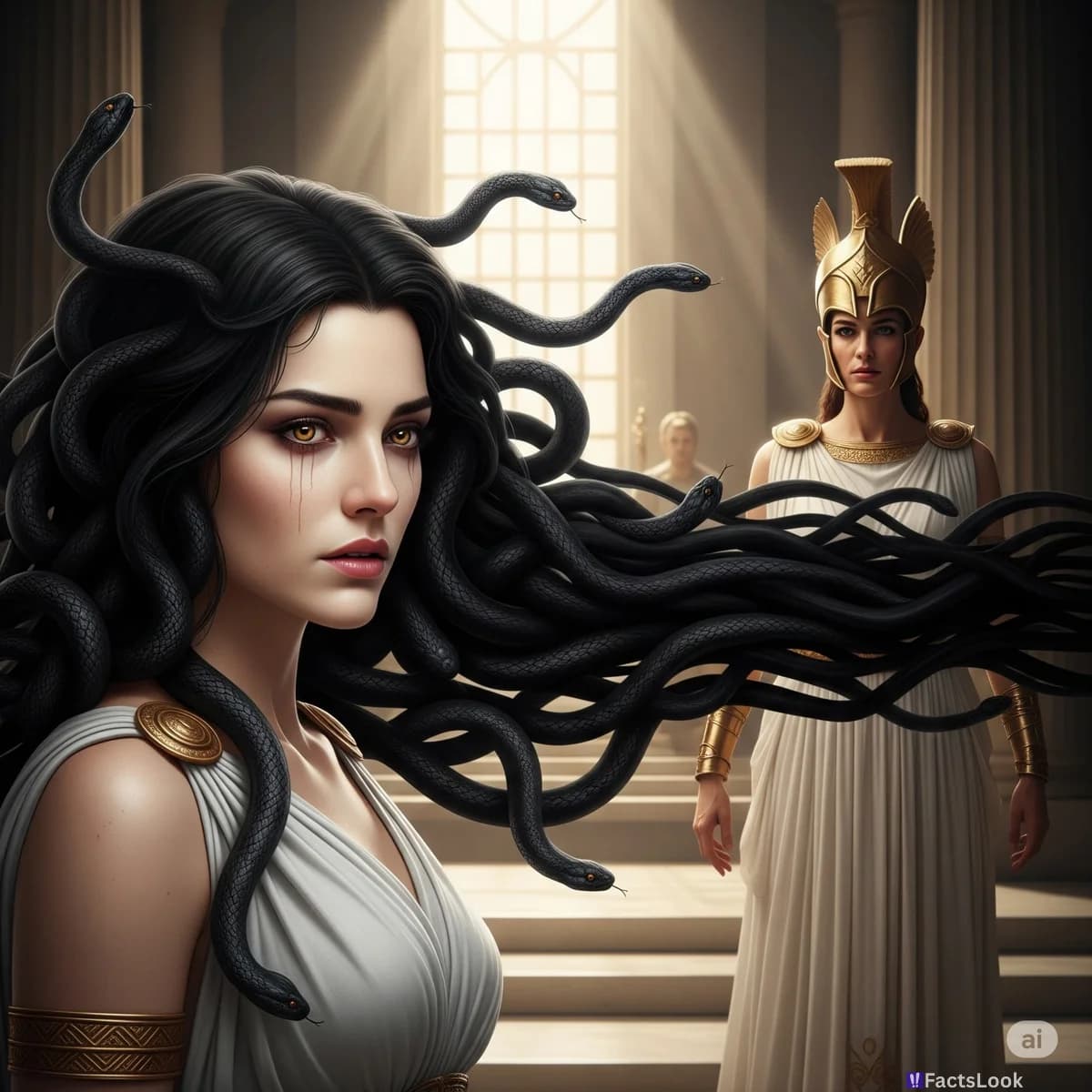
The earliest Greek accounts describe Medusa as a beautiful priestess of Athena — until Poseidon assaulted her in Athena's temple. Athena's punishment? Transforming her hair into snakes. But in the original myth, Medusa was the victim, not the monster. Later retellings, particularly Ovid's Metamorphoses (8 CE), reframed her as a Gorgon who petrifies with a glance. Modern artists have since reclaimed her as an emblem of female rage and power. A 2019 Dartmouth exhibit called "More than a Monster: Medusa Misunderstood" documented how her image now appears in feminist street art, academic essays, and protest iconography as a symbol of women defying male-dominated structures. Her head on Athena's shield — the aegis — is one of the most enduring power-dressing images in Western art. The myth went from blaming the victim to empowering her.
Source: Dartmouth University — Medusa Misunderstood; Art UK — Rethinking Medusa.
The Achilles' Heel: From Myth to Medical Term
When Thetis dipped her infant son Achilles in the River Styx to make him invulnerable, she held him by the heel — the one spot the water didn't touch. An arrow to that heel killed him at Troy. Today, the Achilles tendon — the thick band of tissue connecting your calf to your heel bone — is named for exactly that spot. It's the largest tendon in the human body, and it ruptures more often than any other. "Achilles' heel" as an idiom for a fatal weakness entered English in the 1690s, and it now appears in medical literature, business strategy, and cybersecurity reports. The myth didn't just give us a metaphor; it gave anatomy its vocabulary.
Source: Merriam-Webster — Achilles' heel definition; HistoryExtra — Why Do We Say 'Achilles Heel'.
Ragnarok: Norse Apocalypse to Video Game Title
Ragnarok — the Norse end-of-the-world event — follows a specific arc: fire and flood destroy the current world, two surviving humans emerge, and a green, fertile Earth repopulates itself. That's not just destruction; it's a reset. The Prose Edda (13th century) recorded what earlier Norse sources described, and the structure — apocalypse followed by renewal — became the template for post-apocalyptic fiction ever since. More recently, the word gave its name to one of the best-selling action-adventure games of the 2020s: God of War Ragnarök (2022), which drew directly on the Eddas for its story. The 2011 Marvel film Thor and the 2017 game God of War between them introduced millions of people to Norse mythology who had never cracked an Edda. If you've played it or watched it, you've read Ragnarok.
Source: Wikipedia — God of War Ragnarök; HistoryExtra on the mythology's influence.
Ra's Solar Barque: A Nightly Journey That Became a Trope
Every night, the Egyptian sun god Ra sailed through the underworld (Duat) in a boat called the Boat of Millions of Years, fighting demons and chaos before being reborn at dawn. The underworld wasn't a static place of punishment — it was a transit zone, a dangerous passage the sun had to survive to return. This journey underlies the modern story structure of "descent into the underworld and return" — the hero enters darkness, faces trials, and emerges transformed. It's the plot of Dante's Inferno, the skeleton of every dungeon-crawl video game, and the premise of films like Journey to the West. The Egyptian image of the sun god navigating hostile waters through a dark realm is, essentially, the world's oldest video game level.
Source: Britannica — Egyptian Mythology on Ra's nightly journey.
Tír na nÓg: The Land That Gave Fantasy Its Enchanted Realm
Tír na nÓg ("Land of the Young") is a supernatural realm in Irish mythology where inhabitants never age, food grants immortality, and time moves differently — a year there equals centuries in the mortal world. According to tradition, returning to the mortal realm after visiting causes rapid aging. This specific detail — that time runs differently in the enchanted land, and leaving it ages you — is a detail J.R.R. Tolkien drew on directly for Lothlórien in The Lord of the Rings, where the elves live outside mortal time. The trope of the timeless realm from which mortals return aged or changed appears in fairy tale after fairy tale, from Scottish ballads to modern romance novels about supernatural lovers. If you've ever read a fantasy novel where a character returns from an enchanted forest having barely aged, you've met Tír na nÓg.
Source: Britannica — Celtic Mythology on Tír na nÓg.
Prometheus: The Original Whistleblower
Prometheus stole fire from the gods and gave it to humanity — an act that, in modern terms, looks less like a gift and more like a data breach. His punishment: chained to a rock while an eagle ate his liver daily, which regrew overnight, so the suffering never ended. The liver was chosen because it is the one human organ that genuinely regenerates — an anatomical fact the ancient Greeks somehow intuited without knowing why. The image of one individual suffering eternally for giving knowledge to others has made Prometheus the archetypal figure for civil disobedience and principled dissent. Galileo, Voltaire, and — more recently — WikiLeaks founder Julian Assange have all been described in these terms. The word "Promethean" now appears in discussions of innovation, open-source software, and scientific ethics. He gave humanity fire; we gave him a metaphor.
Source: Britannica — Prometheus; PMC/NIH — Achilles as Eponymous on the liver's regenerative properties.
Amaterasu: The Sun Goddess Who Still Has Active Shrines
Amaterasu (天照, "she who illuminates the heavens") is the supreme sun goddess in Shinto mythology, first recorded in the Kojiki in 712 CE. When her brother Susanoo caused chaos, she withdrew into a cave and plunged the world into darkness — the other gods had to perform a comedy routine involving laughter and chaos to coax her out and restore light. She remains the most important deity in Shinto worship, and her descendants are said to have founded the Japanese imperial line. At Ise Jingu, one of Japan's holiest shrines, rituals have been performed daily for over a thousand years in her honor. The Japanese flag — a red circle representing the sun — is often interpreted as a symbol of Amaterasu. She is, in a very concrete sense, still on the national flag.
Source: Wikipedia — Amaterasu; Nippon.com — Amaterasu: The Japanese Sun Goddess.
Ranginui and Papatūānuku: The Māori Parents of the World
In Māori cosmology, the sky father Ranginui and the earth mother Papatūānuku were locked in a tight embrace, leaving their children — the gods — in darkness. The god Tāne Mahuta pushed them apart, creating the world of light and space between sky and earth. This story frames separation and balance as sacred acts, not conflicts. The concept of environmental guardianship drawn from this worldview has shaped contemporary land stewardship movements in Aotearoa New Zealand. Tāne Mahuta — the oldest known kauri tree in New Zealand, estimated at up to 2,500 years old — is named for the god who separated the parents. The naming of a living forest after a mythological figure is not metaphorical; it reflects a belief system in which the two are continuous.
Source: Britannica — Māori Mythology; Wikipedia — Indigenous land rights in Australia on the legal framework.
Indra's Defeats: Even Kings of Gods Get Humiliated
Indra, king of the Vedic gods, was repeatedly defeated by demons in ancient Hindu texts — Vritra, a serpent-demon who blocked the rivers, and the asura Vemala, among others. In some accounts, he lost his throne entirely and had to seek help from other deities. This is striking precisely because most mythologies portray their king-of-gods as invulnerable. The Hindu sources don't flinch from it: Indra is powerful, but he is also routinely bested. The pattern — a powerful figure whose authority is constantly tested and sometimes lost — shows up everywhere in modern storytelling, from political dramas to corporate thrillers. It's a surprisingly democratic note for mythology to strike: even the king of the gods has bad days.
Source: Britannica — Indra on his mythological defeats.
The Aztec Five Suns: Five Versions of the World
The Aztecs believed the current world was the fifth in a series, each created and then destroyed by a different deity — the first age ended in jaguars eating all the giants, the second in hurricanes, the third in a rain of fire, and the fourth in a global flood. The current Fifth Sun is predicted to end in a massive earthquake. This cyclical model — in which "worlds" end and begin — directly influenced the modern concept of "ages" in fantasy and science fiction worldbuilding. The idea that the current world has a destruction date is the premise of countless end-of-world narratives, from the Marvel Cinematic Universe to the Halo video game series. The Aztecs mapped time in a similar way: each Sun is a distinct era with its own rules. That's not so different from how modern fiction thinks about "eras" or "ages."
Source: Britannica — Aztec Mythology on the Five Suns.
The Wild Hunt: Celtic Ghost Story That Haunted Europe
The Wild Hunt is a folklore motif found across Celtic and Germanic regions — a spectral huntsman (sometimes Woden/Odin, sometimes a figure called the Horned God) drives a pack of ghostly hounds across the night sky. Encountering the Hunt was considered an omen of death or catastrophe. Versions of this motif show up in Arthur Conan Doyle's 1924 short story "The Adventures of the British Service," in the Elder Scrolls video game series, and in the gothic atmosphere of countless horror novels. The image of spectral hunters racing across storm clouds has never really left horror fiction — it's one of the oldest continuous horror tropes in Western literature. Our modern ghost story canon runs deeper than we usually admit.
Source: Britannica — Celtic Mythology on the Wild Hunt.
Nüwa: The Goddess Who Built and Repaired the World
The Chinese goddess Nüwa is credited with creating humanity from yellow clay and, crucially, repairing the pillar of heaven when it broke — preventing the world from collapsing into chaos. In the myth, she melted stones of five colors to patch the sky, which gave the world its imperfect but beautiful atmosphere. Her story is one of the few ancient creation myths centered on a female figure actively saving the world through craft and labor rather than warfare. This archetype — the female maker who repairs what is broken — has been a major influence on modern fantasy worldbuilding, particularly in works featuring powerful sorceresses who reshape reality. She's also one of the few creator gods whose defining act is repair rather than destruction. If you've read a fantasy novel where a powerful woman holds the world together with magic, you may be closer to Nüwa than you think.
Source: Britannica — Chinese Mythology on Nüwa.
The Styx: The River That Made Unbreakable Oaths
The River Styx wasn't just a river in the underworld — it was the mechanism by which the Greek gods swore their most binding oaths. According to the Iliad, when a god swore by the Styx and broke that oath, the penalty was total destruction. Thetis dipped Achilles in the Styx to make him invulnerable — except the heel she held. That one gap is why we still say "Achilles' heel" for a fatal weakness. The Styx's role as a cosmic contract-maker is the direct ancestor of every magical oath, blood pact, and "unbreakable deal" in fantasy fiction, video games, and even legal thrillers. The moment in a fantasy story when a character says "I swear on my life" — and something magical enforces it — is the Styx, still running.
Source: Merriam-Webster on the Styx's oath-binding role; Britannica — Greek Mythology.
Loki: The Norse Trickster Who Defied Gender Categories
Loki is best known as a trickster in Norse mythology, but the Prose Edda describes him giving birth to a horse (Sleipnir, Odin's eight-legged horse) and shapeshifting into a female giant to interfere with Thor's journeys. In one episode, he transforms into a woman, breastfeeds, and argues with the other gods — all in the same narrative. This explicit gender fluidity in Norse sources has made Loki a touchstone for modern discussions of gender identity. Contemporary reinterpretations across Marvel comics and the HBO series Loki (2021–2023) have deliberately explored this dimension. The show's very premise — a version of Loki navigating multiple timelines — is rooted in the idea that he is fundamentally shape-shifting, multivalent, and impossible to pin down. That's not a modern invention; it's in the Eddas.
Source: Wikipedia — Norse Mythology on Loki's shapeshifting; Britannica.
Bastet: From Lioness Warrior to Cat Goddess
Bastet began as Sekhmet, a fierce lioness goddess of war and protection, before evolving into the gentler cat goddess of music, fertility, and domestic life. The shift from lioness to cat mirrors a broader transformation in Egyptian divine imagery — power that is fierce and dangerous becoming power that is protective and close to the home. Cats in ancient Egypt were so revered that killing one — even accidentally — was punishable by death. Today, the cat goddess's influence shows up everywhere: in the Warriors book series (which features clans of cats with spiritual warrior codes), in the lion-goddess figures of Disney's The Lion King, and in the broader cultural comfort with powerful female figures who are simultaneously fierce and nurturing. The original Bastet was both of those things at once. We've just been catching up.
Source: Britannica — Egyptian Mythology on Bastet and Sekhmet.
Viracocha: The Bearded Creator Who Walked on Water
Viracocha, the Incan creator god, is depicted wearing a tunic and a beard — a visual almost never seen in pre-Columbian art, where gods were typically shown clean-shaven. According to myth, he created the sun, moon, and first humans, then walked across the Pacific Ocean to the west, promising to return. The unusual beard and tunic make him visually distinct from every other pre-Columbian deity — and historians have noted the parallel with a later, better-known prophecy of a bearded figure who would return from the sea. Whether that parallel is coincidence or not is debated, but it is one of the stranger coincidences in comparative mythology. Viracocha's walking away and promising to return is, in any case, a story about a creator who leaves — and that narrative structure shows up in countless modern stories about absent gods and prophesied saviors.
Source: Britannica — Incan Mythology on Viracocha.
Arachne: The Weaver Who Became a Spider
Arachne was a mortal weaver in Greek mythology so skilled that she boasted she could out-weave Athena herself. The goddess challenged her to a contest — and when Arachne's work proved flawless, Athena destroyed it in a rage. Arachne's response was to hang herself. Athena then transformed the rope into a web and Arachne into the first spider, condemning her to weave forever. The word "arachnid" — the entire biological class for spiders and scorpions — comes directly from her name. The phrase "spinning a yarn" has genuine mythological roots: Arachne literally spun thread from her own body. In video games from God of War to Hades, spider-women and labyrinthine web puzzles trace back to this single story. Her myth endures not just in taxonomy but in every spider-themed horror game you've ever played.
Source: Britannica — Arachne; Wikipedia — Arachnid on the etymology.
5 Common Questions About Ancient Myths — Answered
What is mythology, exactly? Mythology is a body of stories a culture tells to explain the world — how it began, why things are the way they are, and what happens after death. Unlike scripture, myths aren't typically treated as literal truth or divinely revealed; they're narratives that carry cultural values and collective memory.
How do myths influence modern language? Directly, and constantly. "Achilles' heel" for a fatal weakness, "narcissist" for self-obsession, "Pandora's box" for a trap you shouldn't open — these aren't decorative references. They're the linguistic residue of stories so old and so embedded that we use them without knowing their origins. The word "narcissism" wasn't coined until 1898, but the behavior it describes has been named after a myth for over two thousand years.
What is the oldest myth? The Epic of Gilgamesh, composed around 2100 BCE in ancient Mesopotamia, is the oldest surviving written story. It contains a flood narrative that predates the Book of Genesis by roughly a thousand years. It shows up in our post on archaeological discoveries that rewrote history — because unearthing it was itself one of the biggest discoveries in the field.
Why do so many cultures have flood myths? The prevalence of flood myths across cultures — Mesopotamian, biblical, Greek, Hindu, Mesoamerican, Aboriginal Australian — likely reflects actual collective memory of catastrophic flooding events, combined with a universal human experience: rivers flooding and reshaping the landscape. The specifics differ, but the pattern is remarkably consistent.
What's the most influential ancient myth on modern culture? It's hard to pick just one, but the Norse Ragnarok myth has had an extraordinary run: it gave us the word "apocalypse," inspired the structure of post-apocalyptic fiction, and directly named a best-selling video game. For something that supposedly describes the end of the world, it's done quite well for itself.