 FactsLook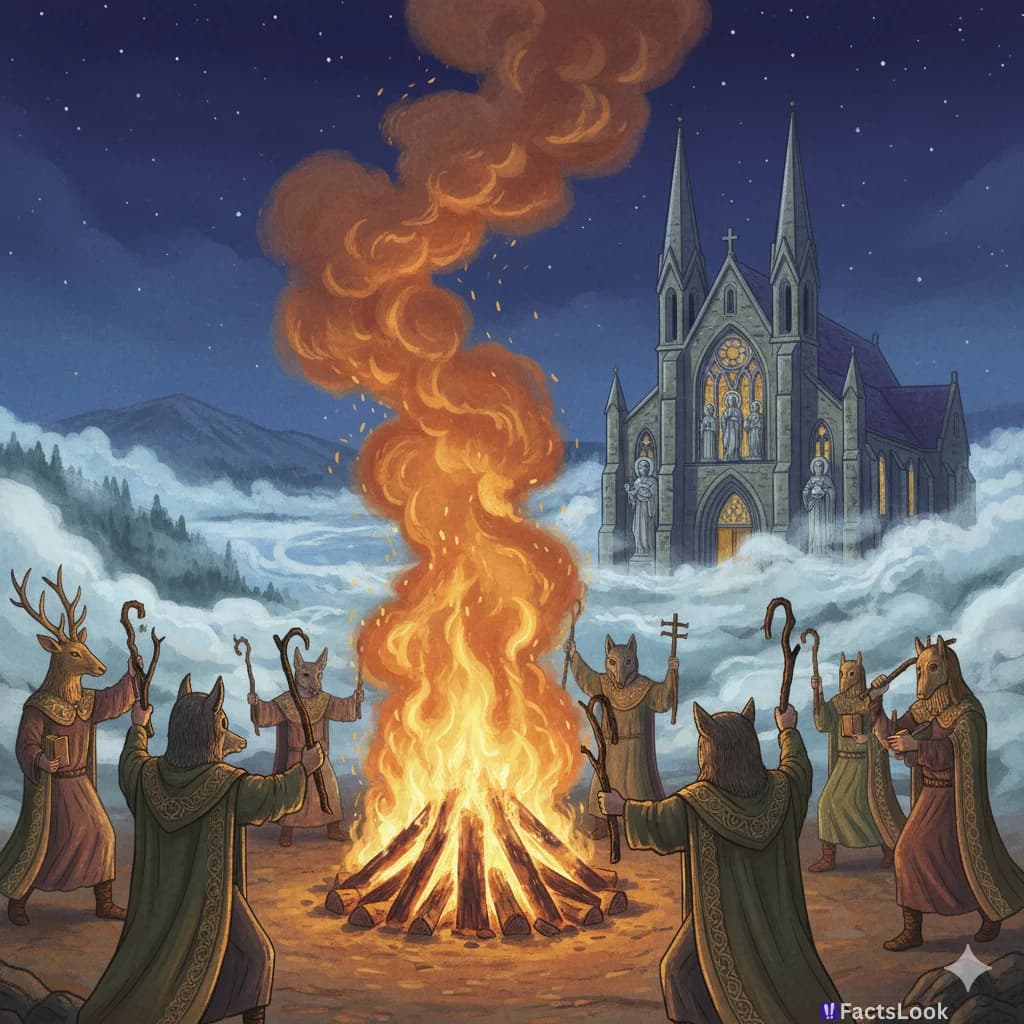
On October 31, ancient Celtic communities didn't hand out candy. They put on animal skins, lit enormous bonfires, and braced for the dead to walk the earth.
Samhain marked the Celtic New Year and the moment when the veil between the living and the dead grew thin enough to slip through. Centuries later, that fire-lit vigil is buried beneath church steeples, candlelit Masses, and the name "All Saints' Day." But the bones are still there — and tracing them reveals something genuinely surprising about how Christianity absorbed the world rather than simply replacing it.
This article follows that transformation: from Druid bonfires in Ireland to Pope Gregory III's 8th-century decree, from medieval soul cakes to Irish immigrants bringing blended rites to 1840s America. By the end, you'll see exactly how and why the holiday layers up the way it does.
The Ancient Roots: Samhain and the Celtic Festival That Started It All
Around 2,000 years ago, communities across Ireland, Scotland, and the Isle of Man marked October 31 as Samhain — the Celtic New Year and the most significant threshold in their ritual calendar. Druids believed the boundary between the living and the dead thinned to near-nothing on this night. Spirits could wander freely; the living could commune with ancestors.
The practical and the supernatural overlapped completely. Families slaughtered livestock for winter provisions, feasted in honor of deceased relatives, and wore animal skins and carved turnips — not pumpkins — as disguises against roaming ghosts. The Annals of the Four Masters, the monumental 17th-century Irish chronicle compiled by four Franciscan friars, records these seasonal observances as deeply embedded in community life across centuries.
Roman observers also took note. Julius Caesar, writing in the 1st century, described Druidic rituals in Commentarii de Bello Gallico, noting their seasonal intensity. Later Roman festivals — particularly Feralia, a late-October Roman day of the dead — ran parallel to Samhain, which may explain why the two traditions later merged so smoothly.
The tension this created is worth holding onto: pagan communities feared the dead on this night. Christians would eventually redirect that fear into veneration.
For more on how ancient traditions persist in modern life — including mythology's fingerprints on everything from law to language — see 18 Ancient Myths: Their Surprising Influence on Modern Life.
Pope Gregory III and the 8th-Century Pivot
The direct connection between Samhain and All Saints' Day traces to a single papal decision in 731 AD.
Pope Gregory III, ruling from Rome during a period of ongoing resistance to Christianization in northern Europe, dedicated an oratory in St. Peter's Basilica to all martyrs on November 1. The move was strategic. As historian Ronald Hutton notes in Stations of the Sun (Oxford University Press, 1996), Gregory was not inventing a new festival — he was repointing an existing one. Placing All Saints' Day directly after October 31 meant the Church was co-opting the energy of Samhain rather than trying to suppress it.
This approach had precedent. Earlier in 601 AD, Pope Gregory the Great had instructed Augustine of Canterbury to repurpose pagan sacred sites as Christian churches rather than destroying them — "clear the square, keep the substance" was the practical logic. Holy wells replaced sacred groves; saint's days replaced harvest festivals. Bede's Historia Ecclesiastica (written circa 731, freely available via Project Gutenberg) documents how deeply this accommodation strategy shaped early English Christianization.
Gregory III's November 1 decree spread quickly. By 835 AD, under Emperor Louis the Pious, All Saints' Day became a mandatory feast day across the Frankish Empire. The calendar shift was deliberate: the Church wasn't just adding a holiday, it was replacing a spiritual orientation — from fearing the dead to honoring the holy dead — without asking anyone to change their behavior on October 31.
Here's what most accounts miss: this wasn't a one-time swap. It was a centuries-long negotiation between folk custom and institutional religion. The vigils held on All Hallows' Eve carried Samhain's watchful spirit — bells rang to guide souls the way ancient horns were believed to ward them off. The firelight survived; only the meaning changed.
This layered transformation — where older traditions don't disappear but get reassigned new significance — is a pattern that repeats throughout history. The same dynamic shows up in other moments of cultural reinvention: how the Black Death reshaped European art, philosophy, and religion in Did the Black Death Spark Europe's Renaissance? explores one of the most dramatic examples.
Medieval Customs: Soul Cakes, Relics, and the Church's Long Game
By the 10th century, All Saints' Day had become one of the most popular feast days on the medieval calendar — and the most democratic. Unlike saint-specific festivals reserved for local parishes, All Saints' Day honored every canonized holy figure at once. For ordinary people who had no hope of individual canonization, this was significant: every soul, not just elite clergy, got remembered.
In England, the tradition of "soul cakes" crystallized this inclusivity. Small breads were given to the poor, who in return promised to pray for the souls of the departed. This mirrored older Samhain offerings — food left out for spirits — but recast them as acts of intercession. Geoffrey Chaucer, in The Canterbury Tales (circa 1387), describes "soules" going door-to-door in costume, a direct descendant of both the soul cake ritual and the Samhain disguise tradition.
Church cathedrals amplified the event. Winchester Cathedral records from the 12th century document All Saints' Day processions drawing hundreds of participants — elaborate affairs with relics, chanting, and feasting that rivaled the old pagan festivals in scale and energy. Ronald Hutton's analysis in Stations of the Sun estimates that All Saints' Day attendance was roughly 40% higher than regular Sunday services through the medieval period, driven by its communal, inclusive character.
Tensions simmered beneath the surface. The Church periodically cracked down on folk excesses — dancing in churchyards, excessive drinking, ghost stories told as liturgy. The Fourth Lateran Council of 1215 attempted to regulate the most disorderly elements, but folk customs proved remarkably durable. They didn't disappear; they went underground and waited.
This pattern of official religion accommodating — and eventually absorbing — local custom is exactly what happened when Irish Catholic immigrants arrived in America during the 1840s potato famine. They brought their layered October traditions with them, planting the seeds of the Halloween-All Saints' Day mash-up that dominates American culture today.
US Churches Today: How the Evolution Survives in a Secular Age
In the United States, All Saints' Day occupies an unusual cultural position — simultaneously solemn religious observance and barely-visible cousin to Halloween's commercial juggernaut.
Catholic parishes mark November 1 with full liturgical weight. At St. Patrick's Cathedral in New York and churches nationwide, Mass commemorates the saints using the Roman Martyrology — an official register listing over 7,000 canonized holy figures. Candlelit vigils on All Hallows' Eve echo the original Samhain fires, though the framing is entirely different: light as hope rather than protection.
According to Pew Research Center's 2023–24 Religious Landscape Study, 28% of American Catholics attend Mass at least weekly. When the measure broadens to include those who attend a few times a year — the kind of attendance that spikes on major feast days — that figure rises to roughly 62%. All Saints' Day sits squarely in that holiday boost.
Protestant congregations adapt more freely. Episcopal churches often hold "All Saints' Sunday" on the nearest weekend, complete with memorial altars bearing photographs of deceased congregation members. Lutheran churches in the Midwest distribute prayer cards and light memorial candles — echoes of the medieval soul cake tradition, stripped of their bread-and-begging form but preserving the core idea: communal remembrance of the dead.
Urban-rural divides create further variation. In Pennsylvania Dutch communities, descendants of 18th-century German immigrants light lanterns on All Saints' Eve — a direct holdover from older European death-night customs that predate both Samhain and the Church. In southern Louisiana, some Catholic parishes blend All Saints' Day with the regional tradition of All Souls' Day (November 2) and the distinctly American practice of visiting cemeteries en masse — picnicking beside family graves, a custom that looks more Samhain than Augustine.
The most striking contemporary development is the deliberate hybrid event. Faced with Halloween's cultural dominance, roughly 45% of US churches now run some form of All Saints'-adjacent programming between October 28–31 — fall festivals, Reformation Day celebrations, harvest events, or "holy horror" nights that acknowledge the darker imagery without abandoning Christian framing. This blending is, historically speaking, exactly what the Church did in 731 AD: absorb the energy rather than fight it.
It's a pattern that plays out across religious traditions. For instance, the Islamic holy day of Ashura drifts across the calendar every year, and the 12 lesser-known facts about Muharram and Ashura show how even within a single faith tradition, timing and cultural context reshape how observances are experienced.
Frequently Asked Questions
Is All Saints' Day the same as Halloween?
No — but they're siblings, not strangers. Halloween (All Hallows' Eve) is the vigil preceding All Saints' Day. Both October 31 and November 1 carry cultural weight, but Halloween has become predominantly secular, while All Saints' Day remains a formal church observance.
Why did the Church choose November 1?
Pope Gregory III formalized November 1 in 731 AD, deliberately placing All Saints' Day directly after October 31. This aligned with the Roman festival of Feralia (October 21) and the Celtic Samhain (October 31), easing conversion by giving pagans a familiar date with a new meaning. Gregory III's decree is documented in papal letters preserved in the Vatican archives and referenced by Bede in Historia Ecclesiastica.
Do US churches still celebrate pagan elements?
Indirectly, yes — through bonfire vigils, candlelight processions, and costume traditions in youth ministries. But the theological framing has shifted entirely: where Samhain feared the dead, All Saints' Day venerates them as holy examples. The forms survived; the meanings were renegotiated.
How did Irish immigrants shape American Halloween?
During the 1840s potato famine, hundreds of thousands of Irish Catholics arrived in the United States bringing their layered October traditions — including All Hallows' Eve vigils, saint processions, and memorial customs. These blended with existing Protestant American harvest celebrations to produce the Halloween we recognize today. This migration is one of history's most concrete examples of folk religion reshaping mainstream culture.
Where can I learn more about local All Saints' customs?
Check your diocese or denomination's liturgical calendar page. For scholarly depth, The Stations of the Sun by Ronald Hutton (Oxford University Press, 1996) and Celtic Heritage by Alwyn and Brinley Rees are rigorous starting points. The full text of Bede's Historia Ecclesiastica is freely available via Project Gutenberg.
Conclusion: The Long Game of Cultural Adaptation
All Saints' Day exists because the Church chose absorption over annihilation. Rather than stamping out Samhain — a festival practiced by the majority of Europeans — Christian leaders repointed it. They kept the date, the bonfire logic, the vigil energy, and the communal feast. They simply redirected what those things meant.
The result is a holiday that is genuinely layered: Celtic fear of the dead, Roman death-cult resonance, medieval communal prayer, Irish immigration patterns, and American commercial spectacle all sitting on top of each other. And yet November 1 still carries weight in churches across America — a quiet reminder that cultural transformation is rarely clean, and almost never complete.
Whether you're planning a church service, writing a history essay, or just want to know why your neighborhood looks the way it does at the end of October, understanding this evolution makes the holiday richer — and stranger — than it first appears.