 FactsLook
Muharram Moves Through Every Season: 12 Surprising Facts About the Islamic New Year
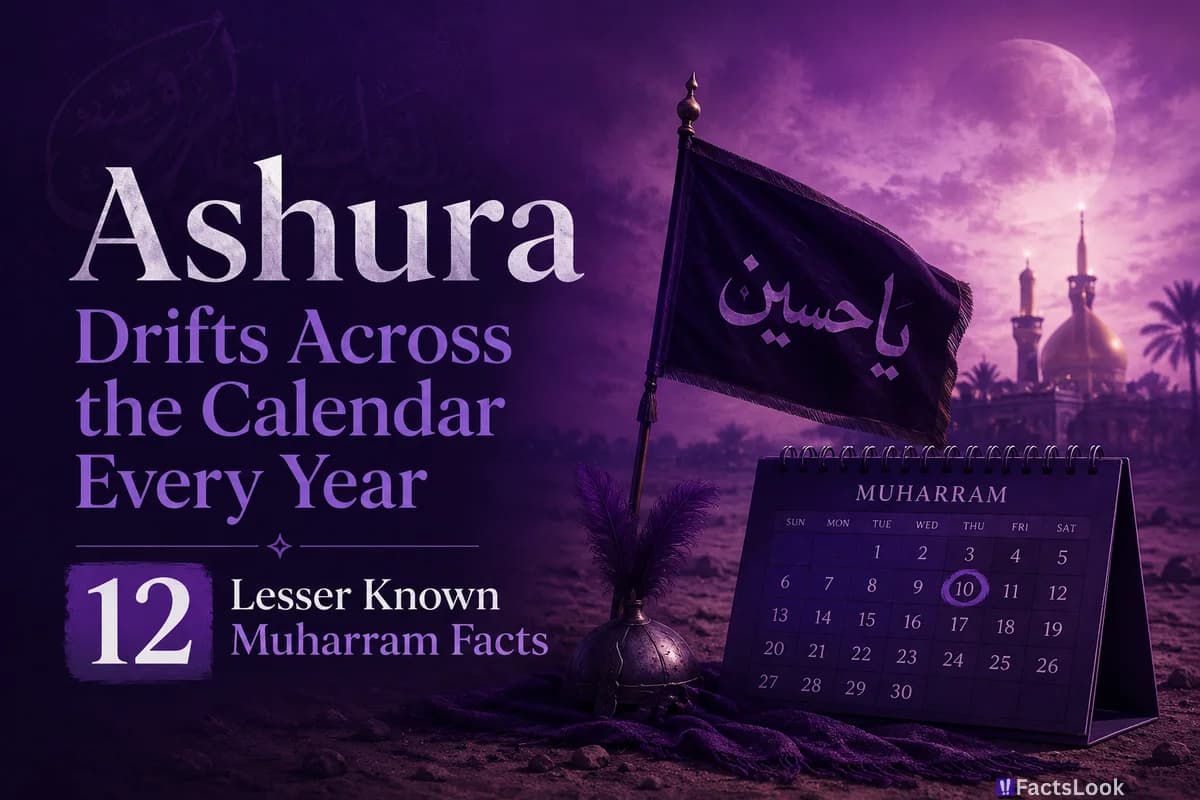
Why Muharram Keeps Catching Outsiders Off-Guard
The Islamic New Year almost never lands where you expect it to.
In any given 30-year stretch, the first day of Muharram drifts through every season — January ice, July heat, spring rain, autumn wind — for roughly 1.8 billion Muslims worldwide.
That single fact rewires most of what follows: Ashura's date moves too, Ramadan slides through the calendar, and the holidays you read about in one year may collide with work or school in another.
What follows are 12 surprising, evidence-backed facts that show why this lunar month matters far beyond the news cycle you usually see it in.
Each item is sourced, and several connect to a much wider pattern we cover in forgotten history and cultural secrets — because Karbala is one story; the diaspora it produced is another.
Muharram Is One of Four Sacred Months Written Into the Quran
Muharram isn't just the first month — it's one of four months the Quran explicitly designates as sacred: Dhul-Qa'dah, Dhul-Hijjah, Muharram, and Rajab.
During these months, warfare and major transgressions were prohibited even before Islam arrived in Arabia — a pre-Islamic code that Islam inherited and deepened.
The Quran references these months directly in Surah At-Tawbah (9:36), calling them Ashhur al-Hurum — the sacred months. Calling something haram (forbidden) in the month of Muharram carries deliberate weight: the name itself echoes the sacred status it holds. (Britannica)
Muharram Wanders Right Across the Gregorian Calendar Every Year
The Islamic calendar is lunar — about 354 days long — so it loses 10 to 11 days against the 365-day solar year each cycle.
Skip ahead 33 years and the same Hijri month has cycled back to roughly the same Gregorian window, the way a slow hand sweeps a clock face.
This is not a glitch. The pre-Islamic Arab calendar was already lunar, and early Muslims kept that rhythm rather than adopting the Julian or Roman solar year. (Yaqeen Institute)
A Muslim in London may fast Ashura in subzero January one year and a heatwave July a decade later — same date, different season, different weather, same observance.
The Hijrah Didn't Happen in Muharram — But Muharram Became Its Anniversary
Here's a fact that surprises even well-read audiences: the Hijrah migration from Mecca to Medina actually occurred in Rabi' al-Awwal, not Muharram.
Yet the Islamic calendar counts from this event — and the decision to do so came later, under Caliph Umar ibn al-Khattab, who recognized the Hijrah as the true turning point of Islamic history.
The migration in 622 CE was more than a physical move. It marked the moment the Prophet Muhammad's community shifted from a marginalized group to a functioning society built on justice and worship.
That transformation — from outpost to civilization — is why the Hijrah became year one. (Muslim Hands UK)
Ashura Unites and Divides Muslims on the Same Day
The 10th day of Muharram — Ashura — is where the month's significance concentrates. For Sunni Muslims, it's a day of fasting that commemorates Prophet Moses being saved from Pharaoh.
When the Prophet arrived in Medina and found Jews observing this fast, he joined them and later encouraged Muslims to do the same, adding that fasting Ashura atones for the previous year's sins. (BBC)
For Shia Muslims, Ashura marks the martyrdom of Imam Hussein ibn Ali at the Battle of Karbala in 680 CE. These aren't contradictory traditions — they coexist under the same date like two rivers sharing a valley.
Both observe the day; both find meaning in it. The overlap is part of what makes the date so layered.
The Battle of Karbala Was Won by the Larger Army and Still Shaped History
In 61 AH (680 CE), Imam Hussein refused to pledge allegiance to Yazid I, calling it a moral line no Muslim should cross. He marched toward Kufa with fewer than 100 companions — women, children, and loyalists — only to be intercepted on the plains of Karbala by an army of thousands sent from Damascus.
The outcome was never in doubt. Imam Hussein and nearly all his family were killed. Their bodies were denied proper burial for days. (Encyclopedia Britannica) What survived was not a victory — it was a symbol.
Karbala became the defining moment of Shia identity: principle over survival, always.
The Hadith on Ashura Fasting Has a Specific Source — and a Specific Number
Islamic scholarship takes traceability seriously. The hadith about fasting on Ashura appears in Sahih Muslim (Hadith 1162), where the Prophet is recorded saying: "Fasting the day of Ashura, I hope Allah will expiate thereby for the year that came before it." (Sunnah.com)
Scholars recommend pairing the fast of the 10th with either the 9th or the 11th — a deliberate move to distinguish Muslim practice from Jewish tradition.
That small precaution reveals how Islamic law evolved: not in isolation, but in conversation with surrounding religious cultures.
Muharram Mourning Has a Centuries-Old Literary Canon
Mourning at Karbala is not improvised. Marsiyas are formal poetic elegies, some running to thousands of couplets, written specifically to recount the tragedy. (The Daily Star)
The genre descends from pre-Islamic risa — Arab lamentation poetry that predates the revelation of the Quran by centuries. The form was inherited, not invented.
The 18th- and 19th-century Lucknow and Hyderabad courts refined Urdu marsiya into a high literary art.
Poets like Mir Anis and Mirza Dagh Delhvi became household names not for love poetry, but for mourning. Karbala didn't just move people; it gave them a verse form.
Tazias Traveled From Karbala to the Caribbean, Fiji, and West Sumatra
The tazia — a bamboo-and-paper replica of Imam Hussein's shrine at Karbala — is carried in Muharram processions across South Asia. (Wikipedia: Tazia)
But the tradition didn't stay in South Asia. Through the 19th-century indentured labor diaspora, tadjabs appeared in Trinidad, Guyana, Jamaica, Suriname, and Fiji.
In Mauritius, the Yamse has been observed since 1790. In Pariaman, West Sumatra, the Tabuik festival began in 1831, introduced by Shia Muslim sepoys stationed there under the British. (Wikipedia: Tabuik)
A shrine replica built in Iraq ended up being rebuilt, paraded, and thrown into the sea in Indonesia — a 7,000-mile migration of a wooden model and the grief it carries.
This fits a broader pattern of religious traditions spreading through trade routes and forced labor migrations. The same pattern shows up in how a pagan celebration evolved into All Saints' Day traditions we know today.
Muharram Is Peak Season for Charity — and the Reason Is Specific
The sacred status of Muharram amplifies the spiritual weight of any good deed, and communities lean into it.
The tradition of Sabil — distributing free food and water — commemorates a specific event at Karbala: Imam Hussein's camp ran out of water before the battle.
Dastarkhwans (community iftar-style meals) feed entire neighborhoods in the days before Ashura.
In Iran, Afghanistan, and parts of Pakistan, wealthier families traditionally sponsor meals for whole blocks during Muharram.
The connection between mourning and generosity isn't symbolic — it's practical. Sharing food during a fast is the most visceral reminder that not everyone has enough.
Majlis Gatherings Are Structured, Not Spontaneous
The image of Muharram mourning as raw, unstructured emotion is misleading. Majlis — mourning assemblies — are formal events with scripts, reciters, and protocols passed down through generations.
Noohas (short elegies) and marsiyas are recited in specific sequences, and physical rituals like matam (chest-beating) follow regional conventions set by local scholars.
The protocols differ from Iran to Iraq to Lebanon to South Asia to East Africa, sometimes sharply.
What looks chaotic from the outside is, inside each tradition, as choreographed as a concert or a lecture series. The grief is genuine; so is the staging.
Karbala's Symbolism Crossed Denominational and Continental Lines
Imam Hussein's stand at Karbala was, at its core, a refusal to legitimize tyranny. The slogan — roughly, "I will not bow to a corrupt ruler" — is older than modern political language.
That framing has been borrowed well beyond Shia Islam. Civil rights leaders, anti-colonial movements, and human rights advocates across faiths have invoked Karbala.
Archbishop Desmond Tutu drew on the parallel during the anti-apartheid struggle. Enslaved and indentured Caribbean communities in the 19th century saw their own suffering in the Karbala story — and the parallel was deliberate, not accidental.
It also helps explain why this narrative keeps travelling. We explored a similar throughline in ancient myths and their surprising influence on modern life — old stories keep shaping new movements long after the original events are over.
The Same Story Sounds Different in Every Country It Reaches
From Iran's solemn processions to Iraq's pilgrimages to Karbala, from Indonesia's theatrical Tabuik structures that get paraded into the sea, to the hand-painted alams of the Indian subcontinent, the observation of Muharram is wildly local.
In East Africa, commemoration blends with local Sufi traditions. In Trinidad, the tadjab processions are now intercommunal — drawing spectators and participants well beyond the Indo-Caribbean Muslim community.
In Turkey, despite decades of official secularism, the Ashura pudding (Ashura tatlısı) — a sweet made from wheat, chickpeas, dried fruits, and nuts — is prepared in most households during the month, religious or not.
The dish is said to commemorate the abundance that survivors of Karbala finally had access to. Every culture puts its own ingredients in the same pot, and the pot still says Karbala.
For a parallel look at how everyday foods carry centuries of history in their recipes, our piece on the garlic mistake most cooks make traces a similar pattern of small kitchen habits hiding long cultural stories.
Common Questions About Muharram Answered
What exactly is Muharram?
Muharram is the first month of the Islamic (Hijri) calendar. It is one of four sacred months in Islam, recognized in Quran 9:36, during which warfare and major transgressions are prohibited. The month carries deep religious significance — especially for Shia Muslims who commemorate the martyrdom of Imam Hussein — but it is observed across Muslim communities in various ways.
Why is Ashura important?
Ashura falls on the 10th of Muharram. For Sunni Muslims, it commemorates Prophet Moses's deliverance from Pharaoh, and many fast on this day. For Shia Muslims, it marks the martyrdom of Imam Hussein at Karbala in 680 CE. Both observances carry profound spiritual weight and are rooted in authenticated hadith.
Can non-Muslims attend Muharram events?
Yes. Majlis gatherings are generally open to observers, and many communities welcome respectful non-Muslim attendance — particularly at cultural events in Trinidad, India, Pakistan, and Indonesia, where Muharram processions have become intercommunal traditions.
What foods are traditionally associated with Muharram?
Community meals (Sabil, dastarkhwan) often feature rice dishes, flatbreads, dates, and halwa. In South Asia, noon chah (salted tea) is common during mourning gatherings. In Turkey, Ashura pudding — made with wheat, chickpeas, dried apricots, and pomegranate seeds — is ubiquitous. The foods tend toward the communal rather than the elaborate.
How is Muharram observed in different countries?
From Iran and Iraq's solemn pilgrimages to Indonesia's theatrical Tabuik festivals and the Caribbean diaspora's tadjab processions, the forms vary dramatically. What remains consistent is the emotional core: remembrance, reflection, and the refusal to forget.