 FactsLook
Frozen Fire & Boiling Ice: Contradictory Places That Prove Earth Is Wildly Unique
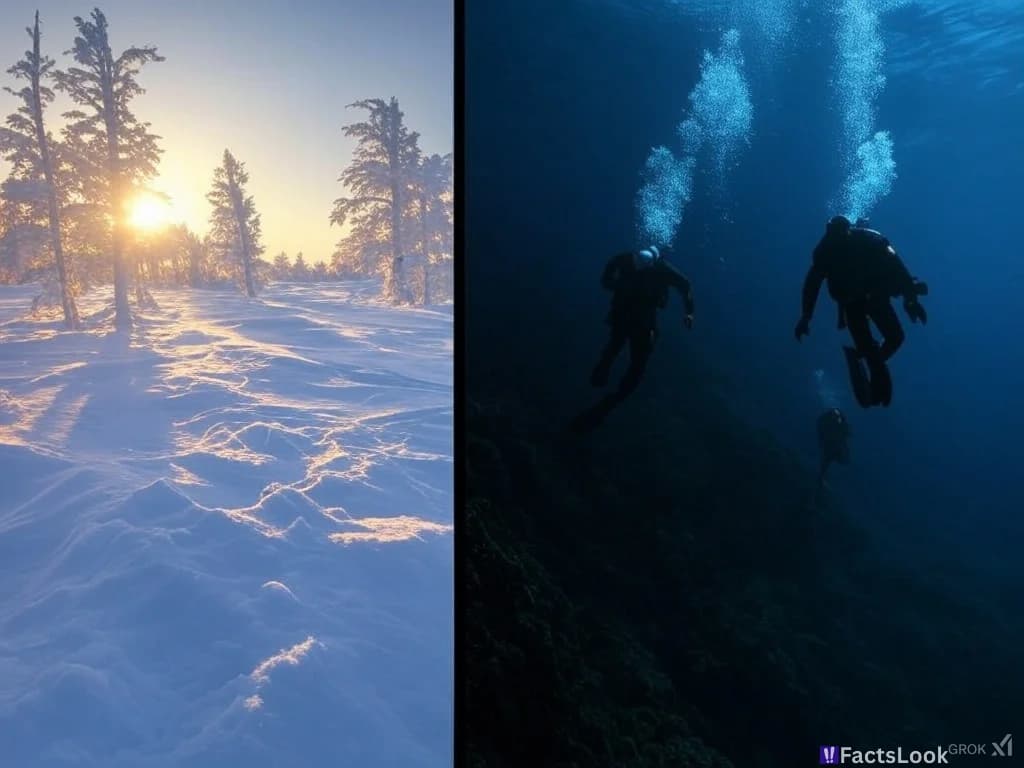
Earth's Thermostat Is Broken — And That's What Makes It Extraordinary
Earth hosts temperatures from -89°C in Antarctica to 56.7°C in Death Valley. That's a 145-degree swing — wider than on any other planet in our solar system. The extremes aren't random. They're the result of Earth's tilted axis, ocean currents, mountain ranges, and atmospheric quirks that scientists are still unpacking. These contradictions make our planet a geological oddity, and understanding them changes how you see weather, climate, and the ground beneath your feet.
1. Hottest Place: Death Valley, USA — 56.7°C, But the Record Is Contested

Pic: timesofindia.indiatimes.com
Death Valley, California, holds the record for the highest verified air temperature: 56.7°C (134°F), recorded on July 10, 1913 at Furnace Creek. The reading has been contested — some meteorologists argue it may have been influenced by instruments and conditions at the time (according to a critical review published in the Bulletin of the American Meteorological Society). Nevertheless, Death Valley remains the benchmark for extreme heat on Earth's surface. The valley sits 86 meters below sea level and is surrounded by mountains that trap hot air. Summer daytime temperatures regularly exceed 47°C, and the mirages that form on the valley floor have fooled travelers for centuries.
2. Coldest Inhabited Place: Oymyakon, Russia — Where Cars Never Stop Running

Pic: wired.com
Oymyakon, a village of roughly 500 people in Siberia's Sakha Republic, once recorded −71.2°C in 1924 — a figure cited by Wikipedia and local meteorological records, though official measurements from that era are limited. The Guinness World Records lists the lowest verified temperature at −67.7°C, recorded in 1933 and again in 2018. Either way, this is the coldest permanently inhabited settlement on Earth. During winter, the sun barely rises, and the ground freezes so hard that funerals sometimes need to wait until the soil thaws. Residents leave car engines running 24/7 because restarting them in extreme cold can crack engine blocks — a quirk that visitors find surreal but locals treat as basic housekeeping.
3. Driest Place: Atacama Desert, Chile — Even NASA Tests Mars Rovers Here

Pic: discovery.com
The Atacama Desert in northern Chile is so dry that some weather stations have never recorded any rainfall at all. The hyperarid core — the driest non-polar desert on Earth — experiences fewer than 1mm of rain per year on average. NASA's Atacama Rover Astrobiology Drilling Studies (ARADS) used the region as a Mars analog because its soil chemistry, UV radiation levels, and extreme aridity closely mimic Martian conditions. The desert's dryness comes from a cold ocean current offshore that prevents moisture from evaporating, combined with a rain shadow from the Andes. Microorganisms called hypoliths survive under translucent stones here, pushing the boundaries of where life can exist. If you're looking for Earth acting most unlike Earth, the Atacama is a strong candidate.
4. Wettest Place: Mawsynram, India — 11.8 Metres of Rain Per Year

Pic: cheggindia.com
Mawsynram in Meghalaya, India, receives an average of 11,872 mm of rain per year (per Wikipedia) — roughly 11.8 metres of water descending annually on this one village. The moisture comes from warm, humid air arriving from the Bay of Bengal and getting shoved upward by the Khasi Hills, where it cools and dumps rain. The result is almost continuous mist and drizzle from April to September. Locals have adapted with living root bridges — structures grown over decades from rubber tree roots — that can support the weight of multiple people and last for generations, something you won't find in any other geography on Earth.
5. Highest Point: Mount Everest — Still Growing 4mm Per Year

Pic: timesofindia.indiatimes.com
Mount Everest stands 8,848.86 metres above sea level as of a 2020 joint survey by Nepal and China (the figure was updated from the earlier 8,848m). It's growing roughly 4mm taller every year due to the ongoing collision between the Indian and Eurasian tectonic plates. The summit has roughly one-third the oxygen concentration of sea level, meaning climbers who attempt it without supplemental oxygen are operating with a body pushed far beyond what evolution prepared them for. Avalanches and ice falls, particularly in the Khumbu Icefall below Camp I, kill more climbers than altitude sickness does. As covered in our urban heat island post, cities trap heat differently — but nothing compares to the altitude challenge on Everest.
6. Lowest Point on Land: Dead Sea — Shrinking by the Decade

pic: reddit.com
The Dead Sea shoreline sits 430.5 metres below sea level, making it the lowest exposed land surface on Earth. Its name is a misnomer — the water isn't truly dead. It supports microbial life, and researchers have found dozens of microbial species adapted to its extreme salinity. What is accurate: the salt concentration (roughly 34%) is nearly ten times that of the ocean, which makes buoyancy so strong that swimming becomes involuntary floating. The water is also receding — the surface has dropped by more than 30 metres since the 1960s due to water diversions from the Jordan River. The shoreline you'll see today won't exist in 50 years.
7. Most Remote Inhabited Place: Tristan da Cunha — No Airport, One Village

Pic: earthobservatory.nasa.gov
Tristan da Cunha, a UK overseas territory in the South Atlantic, is the most remote inhabited archipelago on Earth. The nearest mainland — South Africa or Brazil — is roughly 2,000 km away, and the island group has no airstrip; access is by ship only, and the crossing from Cape Town takes a week. The main island has a population of about 250 people, all living in the single settlement of Edinburgh of the Seven Seas. Potatoes are the staple crop, and fishing for lobster ( exported to the US and Japan) funds the local economy. A 1961 volcanic eruption forced a full evacuation to Britain — the only time the island was abandoned in modern history.
8. Largest Desert: Antarctica — Coldest Desert, Not Hottest

Antarctica is technically a desert, and the math is grim: it receives less than 50mm of precipitation per year over most of its interior. That's less than some of the driest Saharan regions. The difference is that Antarctica's precipitation falls as snow rather than rain. The continent's interior is a high-altitude plateau with extremely low humidity, which means that even though the ice sheet holds roughly 26.5 million cubic km of freshwater — about 60% of Earth's total — it technically qualifies as the largest desert on the planet. The cold air holds almost no moisture, which is why NASA Earthdata notes that clear nights in Antarctica can see temperatures plunge below −70°C without clouds to trap heat.
9. Deepest Point: Mariana Trench — Deeper Than Everest Is Tall

pic: scientificamerican.com
The Mariana Trench's Challenger Deep bottoms out at roughly 10,924 metres (according to Wikipedia), measured during a 2020 expedition using a pressurised autonomous robot. That's nearly 11 km of ocean pressing down on anything that reaches it — the pressure at the bottom exceeds 1,000 atmospheres. Film director James Cameron made a solo descent in the Deepsea Challenger in 2012, reaching 10,908 metres and spending three hours on the floor, where he reportedly said the view looked "just like another planet." The trench is home to microbial organisms that survive on chemical energy from hydrogen and methane seeping through the seabed. For more on deep-sea life, see our ocean creatures post.
10. Windiest Place: Mount Washington — 231 mph in 1934, Still Famous

pic: backpacker.com
On April 12, 1934, observers at the Mount Washington Observatory recorded a wind gust of 231 mph (372 km/h) — a record that stood for decades. The mountain sits at 1,917 metres in New Hampshire, at the confluence of several storm tracks, and its conical shape accelerates air being forced up and over the summit. The observatory has been continuously manned since 1932, and staff still celebrate "Big Wind Day" every April 12. While that 231 mph gust held as the fastest surface wind for nearly 70 years, modern anemometers in typhoons and tropical cyclones have since recorded higher speeds — but Mount Washington's measurement remains the foundation of the site's fame.
11. Most Volcanic Place: Iceland — Born From a Mid-Atlantic Rift

pic: lavacarrental.is
Iceland sits atop the Mid-Atlantic Ridge, where the North American and Eurasian tectonic plates are pulling apart at a rate of about 2.5 cm per year. That geological setting gives the country roughly 130 volcanoes — per the Icelandic Meteorological Office — and eruptions happen roughly every four to five years, with the 2010 Eyjafjallajökull eruption grounding flights across Europe for weeks. The heat from magma below the surface also powers the country's renewable energy grid: roughly 70% of Iceland's total energy comes from geothermal sources, including home heating. The famous Blue Lagoon, a geothermal spa, draws water that's been in contact with basaltic rock at high temperature, picking up minerals and creating the milky blue colour tourists pay premium prices to sit in.
12. Largest Salt Flat: Salar de Uyuni, Bolivia — A Giant Mirror in the Sky

pic: discovery.com
Salar de Uyuni in Bolivia covers roughly 10,582 km² and sits at 3,656 metres above sea level. As Wikipedia notes, it's the world's largest salt flat — a remnant of a prehistoric lake called Minchin that dried up between 13,000 and 42,000 years ago. During the rainy season, a thin layer of water — sometimes just a few centimetres deep — covers the flat and creates a near-perfect mirror that reflects the sky, creating the illusion of walking through clouds. The flat is also a major lithium source, with reserves estimated to represent roughly 70% of the world's known lithium — a fact that makes Bolivia geopolitically significant as the global transition to electric vehicles accelerates.
13. Most Lightning-Prone Place: Lake Maracaibo — The Lighthouse of Venezuela

pic: mashable.com
The Catatumbo lightning over Lake Maracaibo in Venezuela occurs on roughly 260 nights per year — per NASA Earthdata — and produces an average of 233 lightning flashes per square kilometre annually, as reported by Guinness World Records. The phenomenon forms when warm air from the Caribbean Sea gets trapped between the Andes and the lake's shape, creating near-continuous electrical storms. Before electrification was widespread, sailors used the Catatumbo lightning as a navigation beacon — the phenomenon is so consistent that it's visible from up to 400 km away. It's been called the "lighthouse of Maracaibo" for centuries, and it appears in Venezuela's flag as a semicircle of lightning bolts.
14. Most Isolated Uninhabited Place: Bouvet Island — Used as a Movie Set

pic: spectrum.ieee.org
Bouvet Island, a Norwegian uninhabited territory in the South Atlantic, is often described as the most isolated island on Earth. The nearest landmass of any significance is Queen Maud Land in Antarctica, roughly 1,600 km away, and the nearest inhabited settlement is Tristan da Cunha — itself remote — at about 1,750 km. The island is a volcanic remnant, mostly covered in glaciers, and has been recorded with near-zero wildlife beyond occasional seals and penguins on the shoreline. It appears on almost no commercial shipping routes, which makes it a vanishingly rare sight. One curiosity: the island was used as a filming location for the 2004 film "Alien vs. Predator" for its otherworldly terrain.
15. Longest Mountain Range: The Andes — 7,000 km of Geological Connections

pic: livescience.com
The Andes stretch roughly 7,000 km along the western edge of South America, from Venezuela to Chile, making them the longest continental mountain range on Earth. They also include more than 50 peaks above 6,000 metres, including Aconcagua at 6,960 metres — the highest outside Asia. The range was formed by the subduction of the Nazca Plate beneath the South American Plate, a process that continues today and drives the frequent earthquakes along the Pacific Ring of Fire. The Andes also create a rain shadow effect that turns the Atacama into a desert on one side while leaving the wet Amazon basin on the other. In other words: the same geological force that built the mountains is also responsible for two of our other extreme locations.
FAQ: What Are Earth's Other Extreme Records?
What's the coldest non-inhabited place on Earth?
The East Antarctic Ice Sheet's Plateau Station (also called Dome A) has recorded temperatures as low as −89.2°C — according to the World Meteorological Organization. No humans live there permanently, and even the most cold-hardy equipment requires special heating to function. If you're measuring by latitude, the Arctic's Pole of Cold in Oymyakon (the inhabited record) versus the Antarctic's higher altitudes means the answer depends on whether "coldest" means verified temperature or most extreme average conditions.
FAQ: Why Should We Study Extreme Locations?
Why do these extremes matter beyond trivia?
Earth's extremes are the testing ground for life, technology, and climate science. The Atacama teaches us where microbial life can survive on Mars. The Mariana Trench shows us how organisms adapt to pressures we can barely replicate in labs. Mount Washington's wind data feeds into global weather models. Even the Dead Sea's recession is a data point in understanding how human water use reshapes landscapes. Each extreme location is a natural laboratory — and they're getting stranger as climate change nudges temperatures and precipitation patterns beyond historical ranges. As we covered in the urban heat article, even cities we build are now generating new extremes.
Enjoyed This? There's More Where That Came From
Subscribe to our newsletter for a regular dose of fascinating facts! Know a fact we missed? Drop it in the comments with your source.