 FactsLook
10 Empires That Ruled the World: A History of Rise & Fall
Most Empires Fall Faster Than They Rise — And That's the Surprising Part
Rome took centuries to build its road network. The Mongols tore through Asia in decades. The British Empire sat atop a quarter of the globe in 1921—and was largely gone by 1970.
What's going on? Empires don't collapse because one thing breaks. They fall because the same strengths that built them become the weight that sinks them. Overextension. Bureaucratic rot. A military that outgrows the economy funding it. The Romans knew this, the Persians codified it, and the British discovered it the hard way.
Here are 10 empires that got the formula right—until they didn't. And the details might surprise you.
1. The Roman Empire (27 BCE – 476 CE)
Rome's engineering gets framed as a footnote to its military conquests. That's backwards. The aqueducts were the real empire.
At its peak, Rome's eleven aqueducts delivered roughly 1 million cubic meters of water every day—more per capita than many modern cities. Engineers used gravity alone across distances exceeding 100 kilometers, pushing water up to 5-story apartment buildings through lead pipes using nothing but gradient and pressure. WaterHistory.org
The army was impressive. But without that water infrastructure, you don't get a city of 1 million people. You don't get the baths, the sanitation, the public fountains that kept citizens healthy and calm. The roads came later—and they were great—but the water came first.
So what went wrong? The military got expensive. The borders got long. Hiring Germanic soldiers to patch the army created loyalty problems. Plague in the 160s cut the tax base by maybe 15%. The Western Empire didn't fall in a day—it thinned for 200 years until 476 CE was just a date on a calendar. The Eastern (Byzantine) half survived another 1,000 years, partly because Constantinople had better walls and a narrower frontier.
Takeaway: Infrastructure isn't just convenience—it's the load-bearing column of a civilization. Rome understood that. Then it forgot to maintain the other columns.
2. The Mongol Empire (1206 – 1368)
Here's something textbooks rarely mention: the Mongols invented the internet. Well, a medieval version of it.
The Yam was a relay postal network with stations every 20–30 miles. A messenger could hand off his message to a fresh rider and a fresh horse at each stop. The result? News could travel from Central Europe to the Mongol capital in 4 to 6 weeks—a journey that normally took months. Wikipedia: Yam (route)
This wasn't just for military dispatches. Merchants used it. Foreign ambassadors used it. The entire Silk Road stayed open and predictable because Genghis Khan and his successors made speed a feature. Scholars call this period Pax Mongolica—the Mongol Peace—and it's one of the reasons the Black Death also spread so effectively, but that's another story (covered in our piece on how the Black Death shaped Europe's Renaissance).
The Yam system worked because it was ruthlessly maintained. Kill a messenger? Death. Steal a horse from a station? Death. This is empire-building as logistics, not just cavalry.
What killed them? They ran into the same problem every large empire hits: succession. Genghis Khan's empire got split among his four sons, and his grandsons kept fragmenting it further. Add a plague that hit Central Asia hard in the 1330s, and you get the Golden Horde, the Ilkhanate, and the Chagatai Khanate—all separate by 1368. Not a collapse so much as a slow fracture into manageable pieces.
Takeaway: The Mongols won wars by moving information faster than their enemies. When the information network frayed, the empire followed.
3. The Egyptian Empire (c. 3100 – 30 BCE)
Egypt lasted roughly 3,000 years—longer than any other polity on this list. The thing that kept them alive was the Nile, and the thing that eventually killed them was geography.
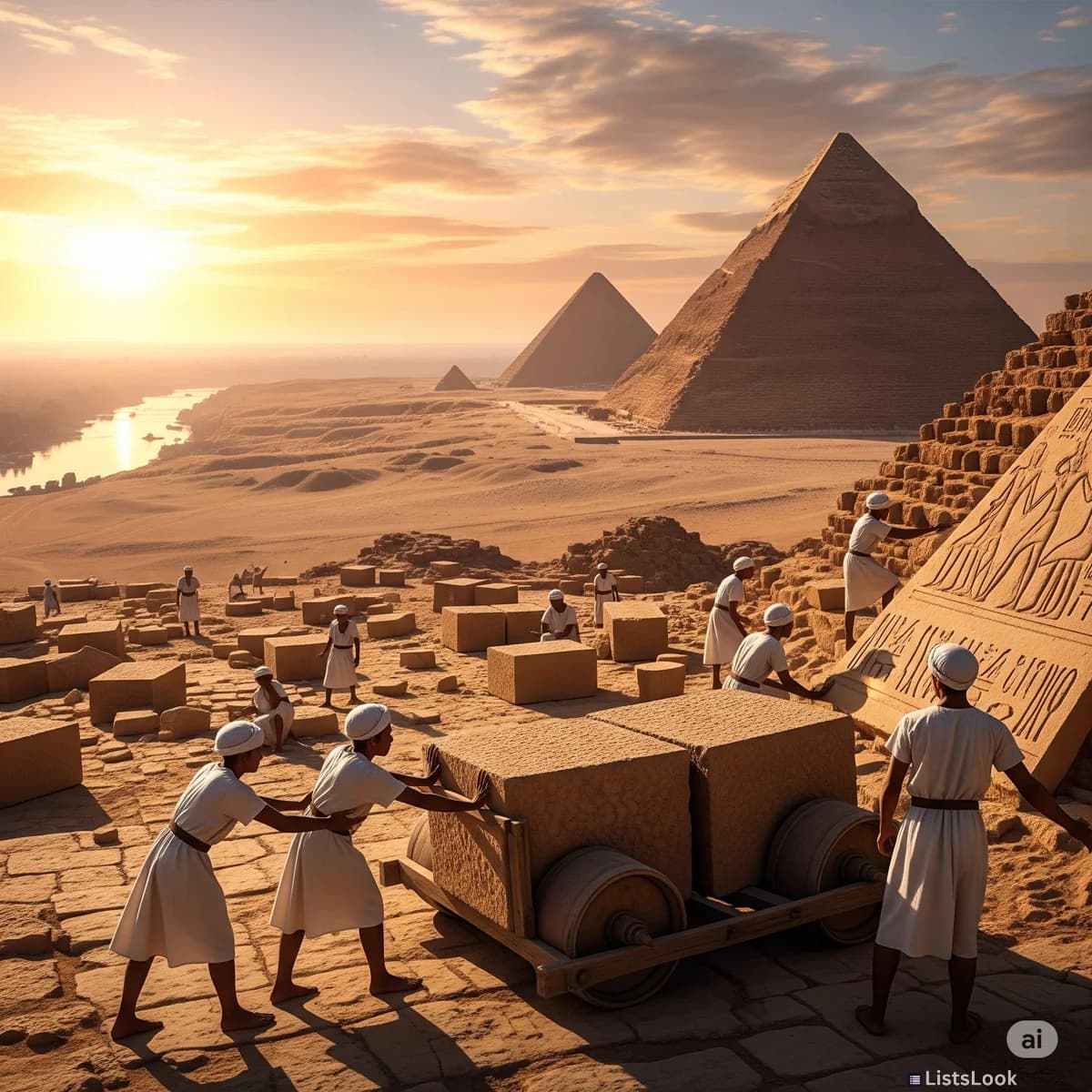
The Nile flooded predictably every summer. That predictability let Egyptian bureaucrats collect taxes, plan construction, and feed cities with remarkable consistency. The pyramids weren't built by slaves—they were built by seasonal farmers during the flood period when there was nothing to farm. Organized labor, not servitude. National Geographic: Egyptian Achievements
The Old Kingdom (2686–2181 BCE) built the pyramids. The Middle Kingdom (2055–1650 BCE) expanded into Nubia and developed trade networks. The New Kingdom (1550–1069 BCE) was the military peak, driving out the Hyksos and building temples at Karnak and Luxor.
What ended it? The Persians under Cambyses II in 525 BCE. Then Alexander. Then Ptolemy. Then Rome. Egypt kept its language and customs longer than you'd expect—Cleopatra was more Ptolemaic than Egyptian by blood—but political independence was gone after Cambyses. They lasted another 550 years as a province of empires that respected the brand.
Takeaway: 3,000 years is a long time, but Egypt's geography made it predictable—and predictability attracts conquerors.
4. The Inca Empire (1438 – 1533)
The Inca had no writing system. No alphabet, no hieroglyphics, no written records. And yet they ran an empire of 12 million people across mountain terrain that would defeat a modern logistics team.
Their solution was the quipu (pronounced KEE-poo)—a set of knotted strings that encoded numbers using a decimal system. Colors indicated categories (textiles vs. grain vs. soldiers). Knot positions indicated values (single knot = 1, long knot = multiples of 10). Government inspectors called quipucamayocs traveled the empire reading quipus and reporting to Cusco. World History Encyclopedia: Quipu
The infrastructure was equally remarkable: 40,000 kilometers of roads, suspension bridges over canyons, and chinampas—floating agricultural beds built on lake sediment—that fed the capital's 200,000+ inhabitants. BBC: Aztec Floating Farms
They fell in under two years. Why? Francisco Pizarro brought 168 men, firearms, horses, and—crucially—smallpox. The Inca had no immunity. Disease killed the emperor Huayna Capac and his designated heir, triggering a civil war between Atahualpa and his brother Huáscar. The Spanish arrived in the middle of that war. Pizarro took Atahualpa hostage in Cajamarca, collected a room full of gold and silver as ransom, then executed him anyway.
Takeaway: No writing system meant no fast communication when it mattered most. The quipu was brilliant—but it couldn't match a Spanish dispatch rider.
5. The Ottoman Empire (1299 – 1922)
The Ottomans built one of the most effective military systems in pre-modern history—and they built it from kidnapped children.
The devshirme system collected Christian boys from the Balkans every few years (typically every 3–7 years). They were converted to Islam, trained as soldiers, and elevated into the elite Janissary corps. Because they had no family connections in the empire, their loyalty was to the sultan alone. Britannica: Devshirme
It sounds brutal—and it was—but it also created one of the most disciplined fighting forces in the medieval world. The Janissaries were the sultan's personal army, numbering 10,000 by the late 15th century and growing from there. They used early firearms before most European armies did, giving them a decisive tactical edge for 200 years.
The system worked until it didn't. Over time, Janissary families started getting their sons recruited by inheritance rather than merit. The corps became hereditary, then politically powerful, then corrupt. By the 17th century, Janissary leaders were deposing sultans they didn't like. In 1826, Sultan Mahmud II arranged a massacre of the Janissary corps to reform the army—and it worked, but only by destroying the institution entirely.
The empire limped on another century, losing territories to nationalism, Russia, and the Great Powers. After World War I, the sultanate was abolished in 1922, and Turkey became a republic.
Takeaway: A system that works brilliantly at one moment can become a liability 300 years later if no one updates it.
6. The Han Dynasty (206 BCE – 220 CE)
In 105 AD, a court eunuch named Cai Lun presented Emperor He with a sheet of processed mulberry bark and hemp fibers. It was lighter than silk, cheaper than bamboo strips, and easier to write on than clay. He called it mázhǐ—paper. World History Encyclopedia: Paper in Ancient China
The Han court didn't think this was world-changing. It was filed as a bureaucratic improvement. But within 200 years, paper had replaced silk and bamboo across China. By 700 AD, it reached the Islamic world after the Battle of Talas. By 1100 AD, it reached Europe. The printing press came a few centuries later—and that's the footnote, but the story starts with Cai Lun in a Han office.
The Han's other innovations: the Silk Road trade network (which sent paper, silk, and porcelain westward), a civil service exam system that selected officials by merit, and a bureaucracy that could collect taxes across 60 million people. This is what scholars call a golden age—and it wasn't accidental.
What ended it? The same thing that ended Rome: overextension, plague, and military pressure on multiple fronts. The Yellow Turban Rebellion (184 CE) was a peasant revolt driven by tax burden and natural disasters. It took decades to suppress. The dynasty never fully recovered, fragmenting into the Three Kingdoms period by 220 CE.
Takeaway: Empires that fund education and trade tend to outlast empires that only fund soldiers.
7. The Mughal Empire (1526 – 1857)
The Taj Mahal took 22 years to build and employed 20,000 workers. But the most impressive Mughal achievement wasn't architectural—it was religious.
Akbar the Great (1556–1605) abolished the jizya tax on non-Muslims, married Hindu princesses, and hosted debates between scholars of different faiths at his court. He created a synthesis of Persian, Hindu, and tribal cultures that made the empire's diverse population actually want to stay part of it. This wasn't just tolerance—it was political strategy that worked.
The Taj Mahal, built by Akbar's grandson Shah Jahan, was a monument to this era: Persian architecture, Indian craftsmanship, and a budget that could fund a small city's infrastructure.
What went wrong? Inconsistency. Akbar's successors—including Aurangzeb—reversed his policies, reimposing the jizya and cracking down on Hindu temples. This alienated the Rajput nobility and the Maratha warrior clans. By the 18th century, the empire was fracturing. Then came the British East India Company, which didn't need to conquer the Mughals—just wait for them to collapse and then negotiate control over the fragments. Britannica: Mughal Empire
The last Mughal emperor, Bahadur Shah Zafar, was tried for treason after the Indian Rebellion of 1857 and exiled to Burma.
Takeaway: Tolerance is easier to build than to maintain—and the moment you reverse it, you give disaffected groups a reason to leave.
8. The Persian Empire (c. 550 – 330 BCE)
Cyrus the Great built an empire that stretched from the Mediterranean to the Indus Valley—and then gave the Babylonians back their god.
After capturing Babylon in 539 BCE, Cyrus issued the Cyrus Cylinder, declaring freedom of worship for all peoples in his empire. He returned idols that previous conquerors had stolen and let exiled populations go home. This was almost certainly political calculation (a stable population rebelled less), but it worked. The Cyrus Cylinder is sometimes called the first charter of human rights—though modern historians debate how sincere that framing is.
What he definitely built was the Royal Road: 1,677 miles of maintained highway from Susa (Iran) to Sardis (Turkey). He installed 111 waystations with fresh horses, food, and rest. A message could travel that distance in 9 days—one-tenth the normal travel time. TheCollector: Cyrus's Postal System
This became the template for every postal system that followed. The Romans borrowed it. The Byzantines borrowed it. The Pony Express in 1860s America was operating on the same principle—and we're still using waystations (called post offices) today.
The empire fell to Alexander the Great, who was genuinely surprised by how quickly the Persian king Darius III fled. Darius was captured by his own nobles and executed. Alexander absorbed the empire in under four years (334–330 BCE). The Persians had run out of capable kings; the army couldn't compensate.
Takeaway: Cyrus's tolerance created stability—but tolerance doesn't survive bad leadership. Darius III was the wrong man at the wrong time.
9. The Aztec Empire (1345 – 1521)
Tenochtitlan was bigger than London. In 1500, it held 200,000–300,000 people, making it one of the largest cities in the world. The Aztecs achieved this by farming on water.
The chinampa system was floating agriculture: wooden frames filled with lake sediment, anchored to the lakebed with willow trees. The beds produced seven crops per year because the soil was nutrient-rich and the water kept roots cool. At its peak, chinampas fed the entire capital. Some beds are still farmed today in Xochimilco. Britannica: Chinampa
The empire also ran on tribute. Conquered peoples paid in goods, labor, and human sacrifice. The Aztec state was efficient at extracting resources from a wide network—which meant it had more enemies than it had subjects. Every city that paid tribute was waiting for an opportunity to switch sides.
They got one in 1519. Hernán Cortés arrived with 600 men, horses, and cannons. But the real weapon was smallpox. The disease reached Tenochtitlan before the second Spanish party, killing Emperor Cuitláhuac and 50% of the city's population within months. The Aztecs couldn't elect a new leader fast enough to organize a defense. Cortés captured the city in 1521—two years after landing.
Takeaway: An empire based on extraction will always have a coalition of former subjects waiting for an opening.
10. The British Empire (16th – 20th Centuries)
The British Empire built itself over 400 years. It dismantled itself in under 30.
In 1921, the empire covered a quarter of the world's land surface and governed 412 million people—one in four humans on Earth. By 1947, it had lost India, its most valuable colony. By 1965, almost nothing remained. BBC: British Raj
The collapse was faster than the rise. Britain spent World War II broke, its industrial capacity damaged, its global influence declining. The United States and the Soviet Union emerged as the new superpowers. Nationalism was spreading through every colony. Britain couldn't pay for the military to hold it all together.
India was the hinge. Once it went—1947, partition, 14 million displaced—the rest followed. Ghana in 1957. Kenya in 1963. The Suez Crisis in 1956 showed Britain couldn't even act alone in its own backyard. The empire ended not with a dramatic defeat but with a quiet retreat, a succession of handovers and treaties and broken promises.
The interesting question isn't why it fell—plenty of empires have fallen. It's why it fell so fast. The answer: it was running an empire on an economy that couldn't sustain an empire, and the moment the war stripped away the buffer, the structural problem became a structural crisis.
Takeaway: Empires can outlast their economic foundation—but not forever.
FAQ: Common Questions About Empires
Which empire lasted the longest?
Ancient Egypt held together for roughly 3,000 years (c. 3100–30 BCE), though it existed as an independent state for much of that period. If you're counting continuous centralized control, the Byzantine Empire lasted about 1,000 years (395–1453 CE). The Roman Empire, broadly defined, spanned roughly 500 years in the West and 1,000 in the East.
Which empire controlled the most land?
The British Empire (early 20th century) covered about 35.5 million km²—roughly a quarter of Earth's land surface. The Mongol Empire at its peak (c. 1279–1309) covered about 24 million km², making it the largest contiguous land empire. "Contiguous" matters: the British had sea lanes; the Mongols didn't need them.
Why do empires fall?
No single cause, but these patterns recur:
- Overextension: Borders get too long for the military to defend.
- Economic strain: Maintaining an army costs more than the empire generates.
- Succession problems: Who rules after the founder dies?
- Internal division: Ethnic, religious, or regional factions stop identifying with the center.
- External pressure: New competitors or technologies shift the military balance.
The Roman, Mongol, Ottoman, and British empires all hit at least three of these.
Was there a 'best' empire?
There's no objective answer—but if you're curious about how empires spread ideas that outlast their politics, our piece on ancient myths and their modern influence covers how empires shaped culture for centuries after they were gone.
Know an empire fact we missed?
There's always one more stone left unturned in history. If you know something that belongs in this conversation—source included—drop it in the comments. That's how facts get better.
And if you want more where this came from, subscribe to our newsletter for a regular dose of the strange, the overlooked, and the genuinely surprising.
This article is for educational purposes. Historical dates and figures are based on widely accepted academic sources. If you're citing a specific claim, check against primary sources or reputable encyclopedias.