 FactsLook
7 Body Language Secrets: What You're Really Saying!

Microexpressions: The Flash You Almost Always Miss

Here's something counterintuitive: most people who claim to read microexpressions well are fooling themselves. A microexpression is a brief, involuntary facial expression that occurs within 1/25th to 1/5th of a second — so fast the conscious brain barely registers it. Paul Ekman, who coined the term and spent over 50 years studying emotion and deception, identified seven universal microexpressions: happiness, sadness, anger, fear, surprise, disgust, and contempt.
Here's the uncomfortable truth: research suggests only about 5% of untrained people can detect microexpressions above chance level. Even trained professionals perform modestly. One NIH study found the upper limit of microexpression duration may be around 1/5 of a second — longer than many assume — yet detection remains difficult. The myth of the "lie spotter" makes for compelling TV; the science is humbler.
Why does this matter? Microexpressions are involuntary — they bypass conscious control and can signal genuine emotion beneath a controlled mask. If you want to sharpen your observation, slow down and watch transitions between expressions. The moment someone switches from a smile back to neutral? That's where truth often leaks. For more on how the brain handles emotional cues, see our post on how stress changes your brain.
Mirroring: The Chameleon Effect

You've probably noticed that friends often adopt similar postures without realising it. Psychologists call this the chameleon effect — nonconscious mimicry of another person's body language, gestures, and facial expressions. Chartrand and Bargh documented this phenomenon in a landmark 1999 study published in the Journal of Personality and Social Psychology.
The kicker: people who are mimicked actually like the person who mimicked them more. Mimicking is not a calculated social tactic — it happens automatically and signals that you're engaged and comfortable. It's a two-way street: mirroring indicates rapport, and building rapport triggers more mirroring. Researchers call this the perception-behavior link — our brains tune into others so deeply that we physically synchronise with them.
In practice, this means that if someone isn't mirroring you at all — no shared gestures, no synchronised breathing — it may signal emotional distance or disinterest. You can also use mirroring deliberately, though sparingly: subtly matching someone's posture over time can lower their guard and increase warmth. Used subtly, it works. Overdone, it reads as mockery.
Eye Contact: It's Not Universal

Here's a fact that surprises many Western readers: what counts as confident eye contact in the US can be read as confrontational in Japan. A University of Tokyo study found that Japanese participants rated faces with direct gaze as more "unapproachable" and "angrier" compared with Finnish participants. Meanwhile, PMC research confirms that Japanese individuals exhibit less eye contact than those from Western European or North American cultures.
Why? In many East Asian societies, prolonged direct eye contact can signal disrespect or challenge, especially in hierarchical contexts. Avoiding eye contact may signal attentiveness and deference, not dishonesty. In business negotiations, Japanese managers have been shown to make less eye contact than their American counterparts — not because they're hiding something, but because the social rules are different.
Pupil dilation adds another layer. Our pupils widen involuntarily when we're emotionally or cognitively engaged — a phenomenon Hess documented in classic studies and the British Psychological Society has explored further. So when someone's pupils dilate while talking to you, it genuinely may indicate interest. Pupils can't be consciously controlled the way words can — which makes them a rare honest signal.
Feet Don't Lie
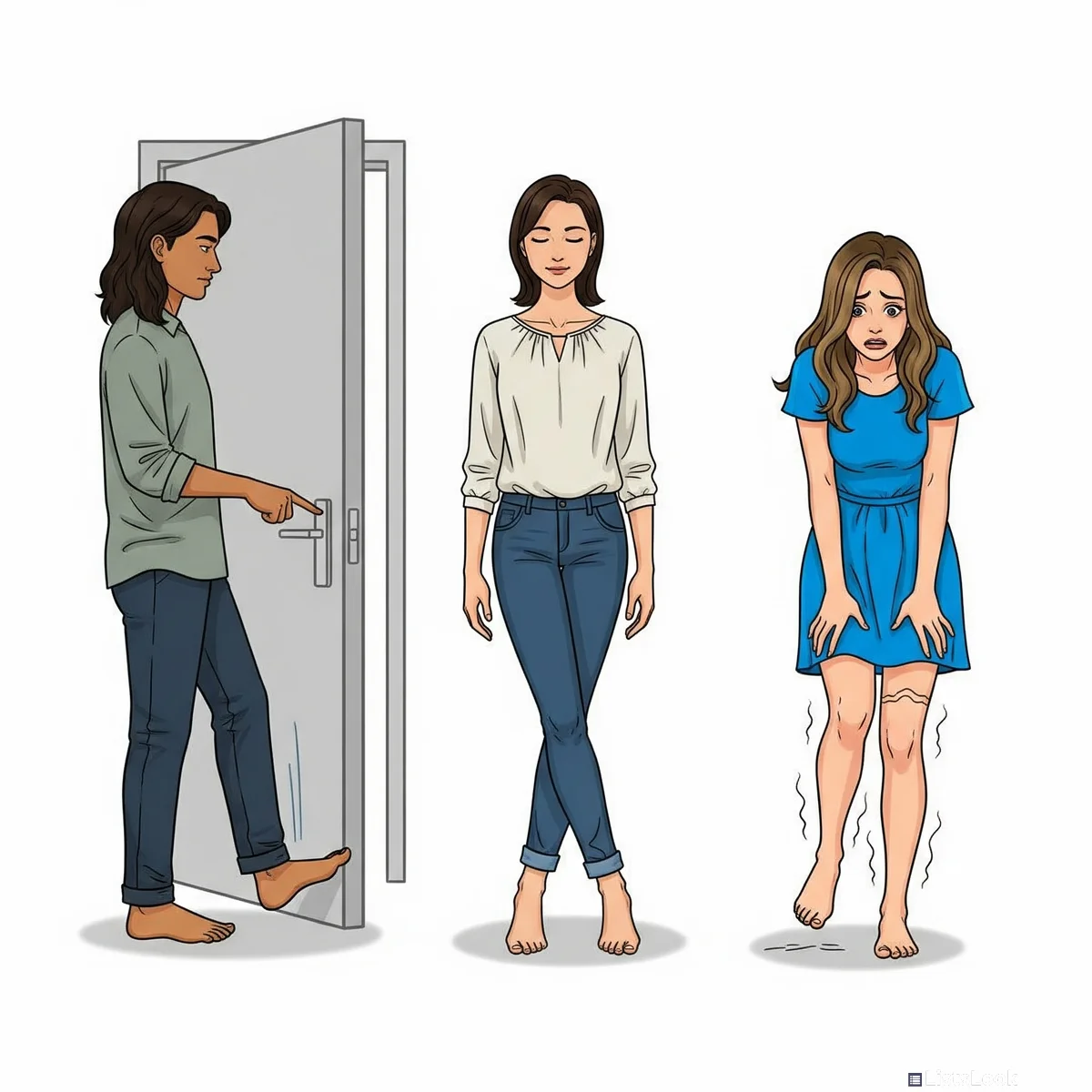
Most people watch faces for emotional truth. Former FBI agent and body language expert Joe Navarro argues we should be watching feet. His reasoning is sharp: by social contract, we control our faces carefully, but our feet often reveal what we genuinely intend.
Feet point toward what we want. If someone's feet are angled toward the door while they're smiling at you, their body may be telling you they'd rather leave — even if their words say otherwise. In a group setting, feet pointing toward a specific person signal engagement or interest in that individual.
Anchoring — keeping feet firmly planted — can indicate hesitation or resistance, while foot tapping usually signals restlessness or impatience. Crossed legs alone mean little; the full context matters. Navarro's point is practical: in an interview, meeting, or conversation, check where feet are pointed. It's one of the harder cues to consciously control, which makes it more honest than the face.
Arms Crossed: Context is Everything

Here's the body language myth that needs retiring: crossed arms always mean defensiveness. It just isn't that simple.
Yes, crossed arms can signal a closed-off posture — but they're also simply a comfortable resting position for many people. Environmental factors matter. Is the room cold? Arms cross for warmth, not emotional shutdown. Context is king, and interpreting a single cue in isolation is where most body language amateurs go wrong.
Body language experts teach cluster analysis — looking at multiple cues together. Are their arms crossed and are they leaning away from you, with feet pointed toward the exit? That cluster suggests discomfort. But arms crossed while leaning forward and maintaining good eye contact? Probably just comfortable. The most reliable reading comes from watching how someone shifts over time, not from snapshot judgments. If you're interested in how our brains process social cues under stress, our post on dreams and their hidden meanings touches on how threat perception affects cognition — relevant context here.
Hand Gestures: Reading Openness and Tension

Hands are among the most expressive parts of the body — and the ones most actively managed during deception. Open palms have signalled sincerity across cultures for millennia; palms-up gestures often indicate honesty or an invitation to trust. The classic negotiator tip — show your palms — has roots in genuine psychology.
Closed fists, hidden hands, and fidgeting tell a different story. Limiting hand gestures while speaking can indicate nervousness, uncertainty, or effort to control nervous energy. Conversely, expansive, open-handed gestures often accompany confidence and enthusiasm — think of a presenter whose gestures match their energy. Watch for sudden changes: someone who goes from animated hands to suddenly still mid-conversation may be masking something.
Palms-up and palms-down also carry meaning in specific contexts. Palms-up often signals submission, openness, or a request; palms-down signals authority or a statement of certainty. In negotiations, a mix of both can be powerful — showing openness while making firm, grounded points.
FAQ: Your Body Language Questions Answered
Can body language be faked?
Yes — and people do it constantly. Skilled liars control their facial expressions, maintain eye contact, and modulate their tone. This is why reading single cues is unreliable; cluster analysis is harder to fake than one isolated signal. Microexpressions are harder to control because they're involuntary — which is why detecting them reliably requires training and still remains imperfect even for experts.
Which body language cue is most reliable?
Feet and legs are harder to consciously control than faces, making them more honest. As Joe Navarro notes, we socialise our faces but often forget our feet. Pair this with pupil dilation (which can't be consciously faked) for a stronger read than any single facial cue.
Does eye contact always mean confidence?
No — it depends entirely on cultural context. In Japan, avoiding eye contact often signals respect, not deception. In the US, strong eye contact suggests confidence, but staring can signal aggression. Always factor in cultural norms before making judgments.
How accurate is reading body language?
Research suggests untrained people perform only slightly better than chance on most cues. Training improves accuracy somewhat, but even experts don't reliably detect deception from body language alone. Body language signals probability, not proof — use it to ask better questions, not to make definitive judgments.
Subscribe to our newsletter for a regular dose of fascinating facts! Know a fact we missed? Drop it in the comments with your source.